
Datavine On-Premise Agent Setup [Windows]
The On-Premise Agent allows the Datavine integration platform to access resources on your network that are not exposed to the internet. It runs as a Windows service, keeps a single outbound connection to Datavine, and needs no inbound firewall rules.
Install
- Download the installer and run it. Windows asks for administrator approval.
- Your antivirus software may complain. This is because the installer has not had wide distribution yet.
- The Datavine Cloud Connector installer is straightforward. Follow the prompts, then click Install.
- At the end of the installation a registration code appears. Give the code to your Datavine contact so they can provision the agent.
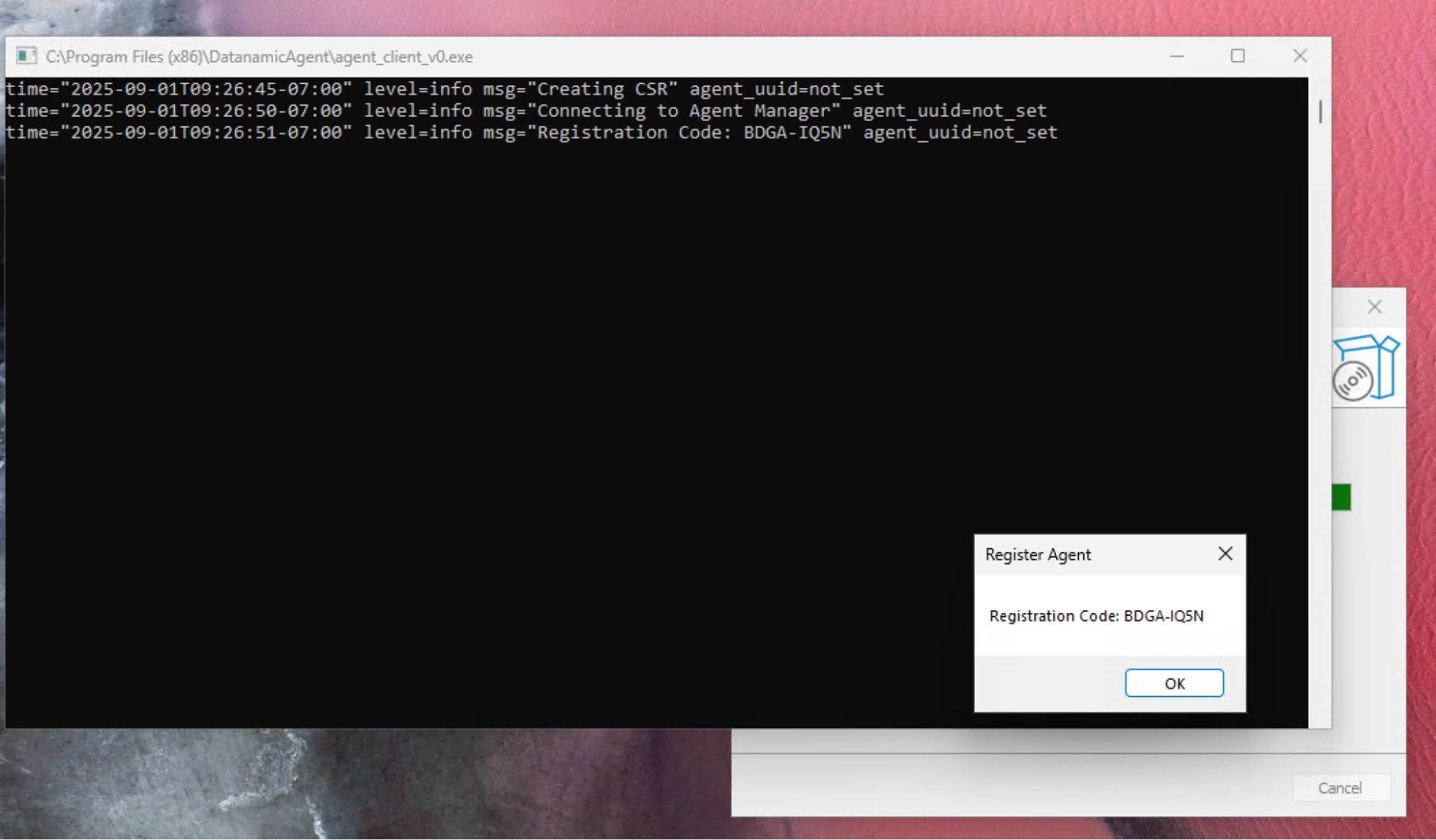
The code is shown in the dialog. Send it, then press OK. - Press OK on the dialog. Provisioning does not finish until you do. The installer then waits until the code is approved and starts the service.
Security
The On-Premise Agent is a lightweight, self-updating process that provides secure, outbound-only connectivity for integration workflows that need access to internal resources. The sections below are the InfoSec fact sheet for the agent.
01Overview
The Datavine On-Premise Agent is a lightweight, self-updating process that enables secure connectivity from your internal network to the Datavine cloud platform for integration scenarios requiring access to internal resources.
- Supported platforms: Windows, Linux
- Distribution: Simple installer; no manual configuration required.
- Use case: Secure, outbound-only connectivity for on-premise integration workflows (no inbound ports needed).
02Deployment & operation
Installation
- The agent is a single binary with minimal dependencies.
- Windows installer and Linux packages (deb, rpm, apk) are available for streamlined setup.
- Runs as a service/daemon; requires only outbound internet access and network access to your requested integration systems.
Agent registration
- Upon installation, the agent generates a unique 8-character registration code.
- The user enters this code into the Datavine platform to link the agent to their account.
- After linking, the agent is issued a unique certificate and re-establishes a secure connection to the platform.
03Authentication & secure communication
mTLS connection
- All communications between the agent and the Datavine cloud use gRPC over mutual TLS (mTLS).
- Each agent is issued a unique certificate (containing a UUID) after registration, used to authenticate future connections.
- Decommissioning an agent revokes its certificate, blocking further access.
No inbound connectivity
- The agent establishes an outbound connection only; no inbound ports are required.
- The agent has no web interface or open API on the customer network.
04Tenant isolation
Per-tenant certificates
Every agent receives a unique certificate bound to a single Datavine tenant. An agent cannot authenticate as, or communicate on behalf of, any other tenant.
Limited communication channels
Each agent has a very strict limit on the actions it can communicate to the cloud platform. The only request an agent can submit is a registration request. After registering and connecting via mTLS, agents are only able to receive requests from the cloud platform.
This ensures that if an agent were compromised, it could not perform any actions in the Datavine cloud.
05Data handling & logging
No customer data or credentials persisted locally
The agent does not store customer data, credentials, or configuration files on disk. All operational data and any integration payloads are processed in memory only.
Certificate storage
The only persistent file written by the agent is the security certificate received at registration. This certificate is required to establish secure, mutually authenticated connections (gRPC over mTLS) with the Datavine platform.
Logging
- Operational logs (errors, connection events) are transmitted to Datavine over mTLS and retained for a limited period in accordance with our platform policy.
- Logs do not contain customer data payloads.
06Updates & maintenance
Self-updating
- The agent can receive updates directly from the Datavine cloud platform via the secure mTLS gRPC connection.
- Updates are performed in place and require no manual intervention.
Zero configuration
All agent behavior is controlled remotely; there are no local configuration files or user-accessible settings.
Decommissioning
Removal of the agent from the platform instantly revokes its certificate, immediately disabling connectivity.
07Security development practices
Vulnerability management
Security patches and updates are released as required and delivered automatically to all installed agents.
08Customer controls
Visibility
- Customers can view all registered agents and their current status. Datavine administrators can also provide historical connection audit logs on request.
- Agent connectivity can be revoked at any time.
Network controls
Customers retain full control over which internal resources the agent can reach via local network policies and firewall rules.
09Compliance alignment
SOC 2
Datavine has completed a SOC 2 audit. The report is available on request from security@datavine.com.